Understanding Care Home Fees
*Accurate as of time of writing April 2026
Navigating care funding and fees in Scotland can feel complex and overwhelming.
Recent media coverage – including a documentary highlighting hidden fees, unexpected upfront costs, and unclear care home pricing across the UK – has only increased the need for reliable information.
In Scotland, free personal care is available to anyone aged 65 and over who is assessed as needing it, regardless of income or savings. Understanding care home fees, free personal care payments, and what is (or isn’t) included in the cost of care shouldn’t be difficult.
Whether you’re learning how free personal care works, comparing care home costs, or planning for the future, we believe in open, honest conversations from the very beginning. That means transparent pricing, no hidden fees, and guidance you can trust - every step of the way.
How much does residential care cost?
The cost of residential care in Scotland is influenced by location, the level of support required, and the specific facilities available. Because fees are tailored to individual needs, we recommend checking carehome.co.uk, where Renaissance Care’s pricing is transparently listed for each of our Scottish sites.
Recent media coverage and industry discussions have highlighted how some care providers present costs, with additional charges sometimes introduced after admission. This has understandably led to increased scrutiny around how residential care fees are structured and communicated.
Typically, care home fees cover accommodation, meals, and personal care. Additional costs may apply for optional services such as hairdressing, private transport, or specialist therapies - these should always be clearly explained in advance.
A transparent approach should always make it clear what is included in the weekly fee - and for those eligible, free personal care payments can help offset some of these expenses.
How much does nursing care cost?
Nursing care involves a higher level of clinical support and 24-hour medical supervision, which is reflected in the weekly fees. Because every resident’s clinical needs are unique, costs are tailored to the specific level of nursing intervention required.
Funding and Contributions
In Scotland, those assessed as requiring nursing support are entitled to free nursing care payments in addition to free personal care allowances. These are flat-rate contributions paid by the local authority directly to the care provider. We understand that calculating how these contributions reduce impact cost can be complex. To ensure you have the most accurate and up-to-date information, we maintain transparent pricing for all our nursing homes on carehome.co.uk .
Families should feel confident that they understand exactly what they are paying for, how funding contributions are applied, and whether any future changes in care needs could affect the cost. Care needs may increase over time, and in some cases, additional services or support may be required. Transparent care providers will always discuss any changes in costs or care requirements in advance.
Private funders vs local authority support
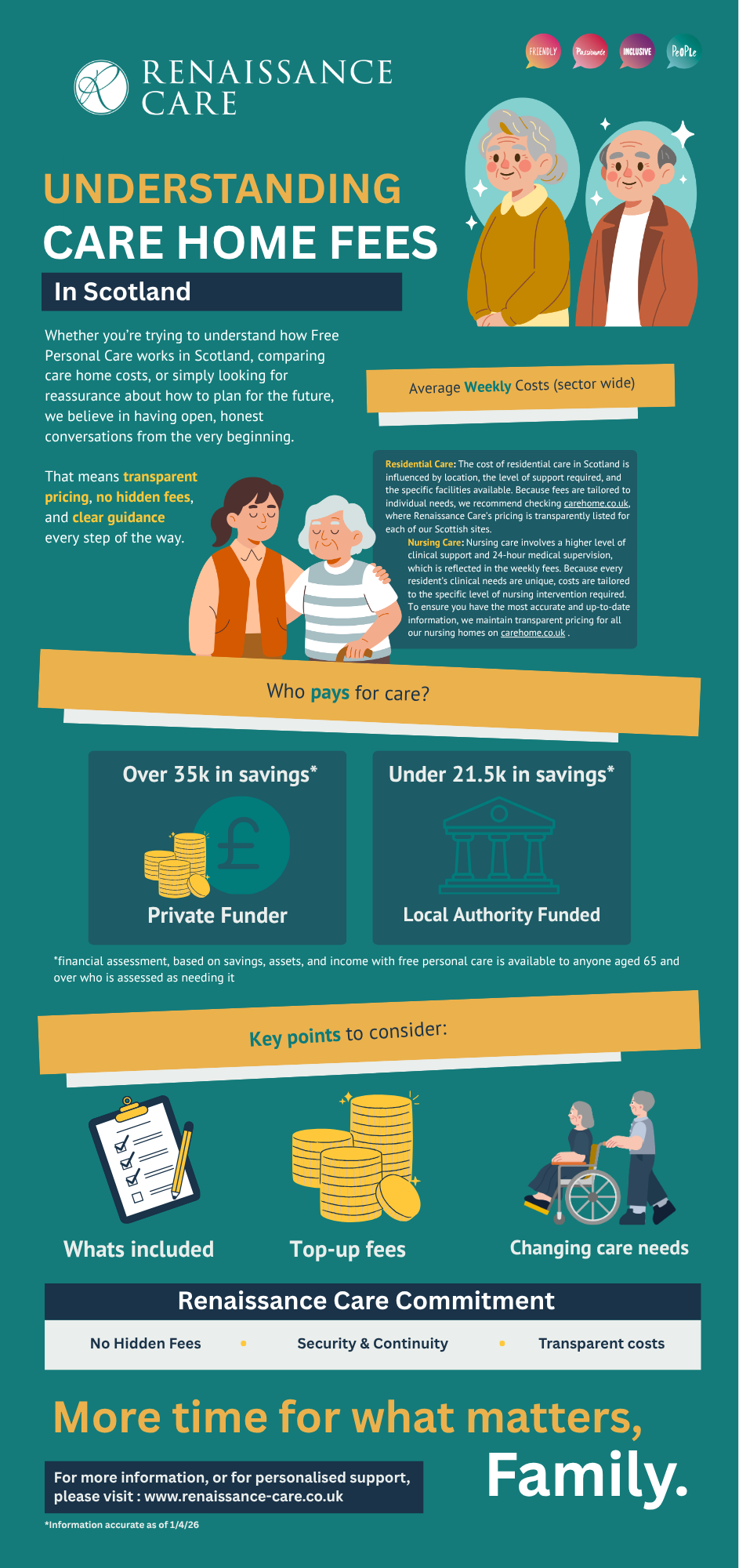
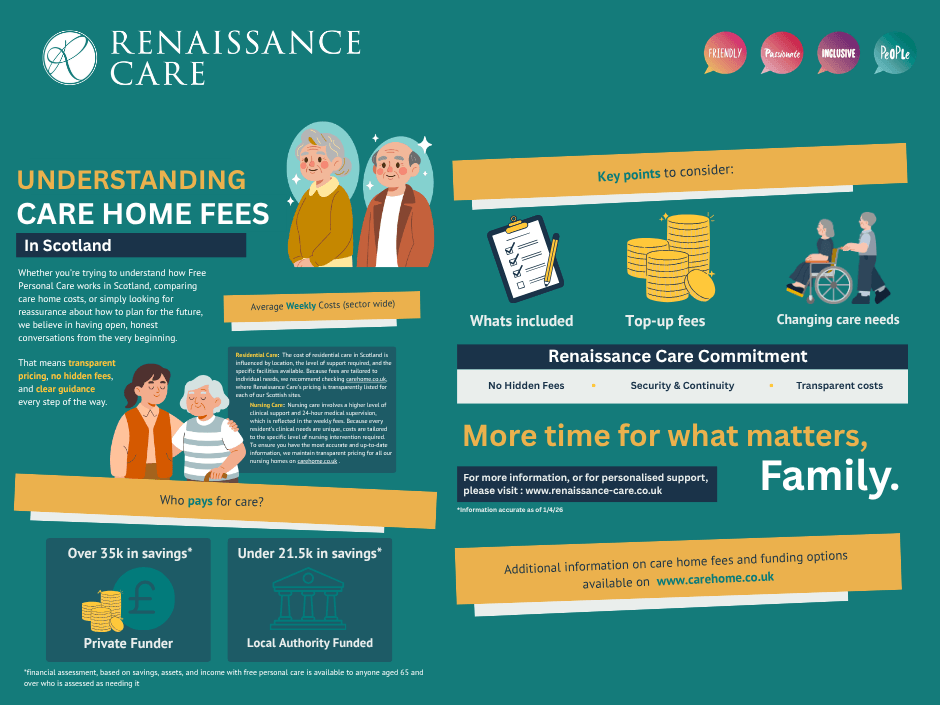
One of the most important distinctions in care funding is whether an individual is privately funding their care or receiving support from their local authority. This is determined through a financial assessment, based on savings, assets, and income.
As a general guide in Scotland, based on current guidance (2026):
• If you have over £35,000 in savings and assets
You will usually be considered a private funder (self-funder), meaning you are responsible for paying the full care home fee. However, if you are assessed as needing personal or nursing care, you will still receive free personal and nursing care (FPNC) payments. These are not means-tested and are paid directly to the care home to reduce your overall bill.
• If you have under £21,500 in savings and assets
You will usually qualify for local authority funding. In this case, the council pays the care home directly. You will still contribute most of your income (such as your state pension), while retaining a personal expenses allowance, currently around £35 per week. Free personal and nursing care payments are included as part of the overall funding arrangement.
• Between these thresholds
A partially funded arrangement may apply, where costs are shared between the individual and the local authority.
Some local authority-funded arrangements may involve a “top-up” fee if a more expensive home is chosen. These should always be discussed and agreed upon transparently in advance.
It’s also important to recognise that care needs and finances may change over time. Transparent providers will ensure that adjustments in costs do not compromise your loved one’s place in the home.
Fees at Renaissance
At Renaissance Care, we understand that finding the right care home for your loved one is an emotional journey, not just a financial one. During this transition, your focus should be on your loved one’s comfort and happiness - not on complicated fees or unexpected costs.
That is why we are committed to complete transparency. When you join a Renaissance Care home, you can expect:
• No hidden fees – What you see is what you get. We provide a clear breakdown of costs from day one, so there are no unexpected “add-ons” for essential care services.
• Simple, honest billing – We handle the logistics so you don’t have to. Our goal is to remove the financial stress, giving you the space to focus on what truly matters: your family.
• Security and continuity – Even if care needs increase over time or your financial situation changes, your loved one’s place remains secure.
If you have any questions about the funding support you may be entitled to, our pricing, or simply need a friendly voice to help explain the options available to your family, our team is here to help. Get in touch today for a confidential chat.
For more information, see our FAQs on funding
View our infographic on funding